Table of Contents
- What Is SEO?
- Why SEO Matters More Than Ever in 2026
- How Search Engines Work: Crawling, Indexing and Ranking
- What Decides Your Rankings? The Core Ranking Factors
- The Four Pillars of SEO
- Local SEO: Winning Customers Near You
- Keyword Research: Where Every SEO Journey Begins
- How to Start SEO: A Step-by-Step Process
- White Hat vs Black Hat SEO
- Essential SEO Tools for Beginners
- How to Measure SEO Success
- Common SEO Mistakes to Avoid
- How Long Does SEO Take to Work?
- The Future of SEO
- Frequently Asked Questions
- Final Thoughts
1. What Is SEO?
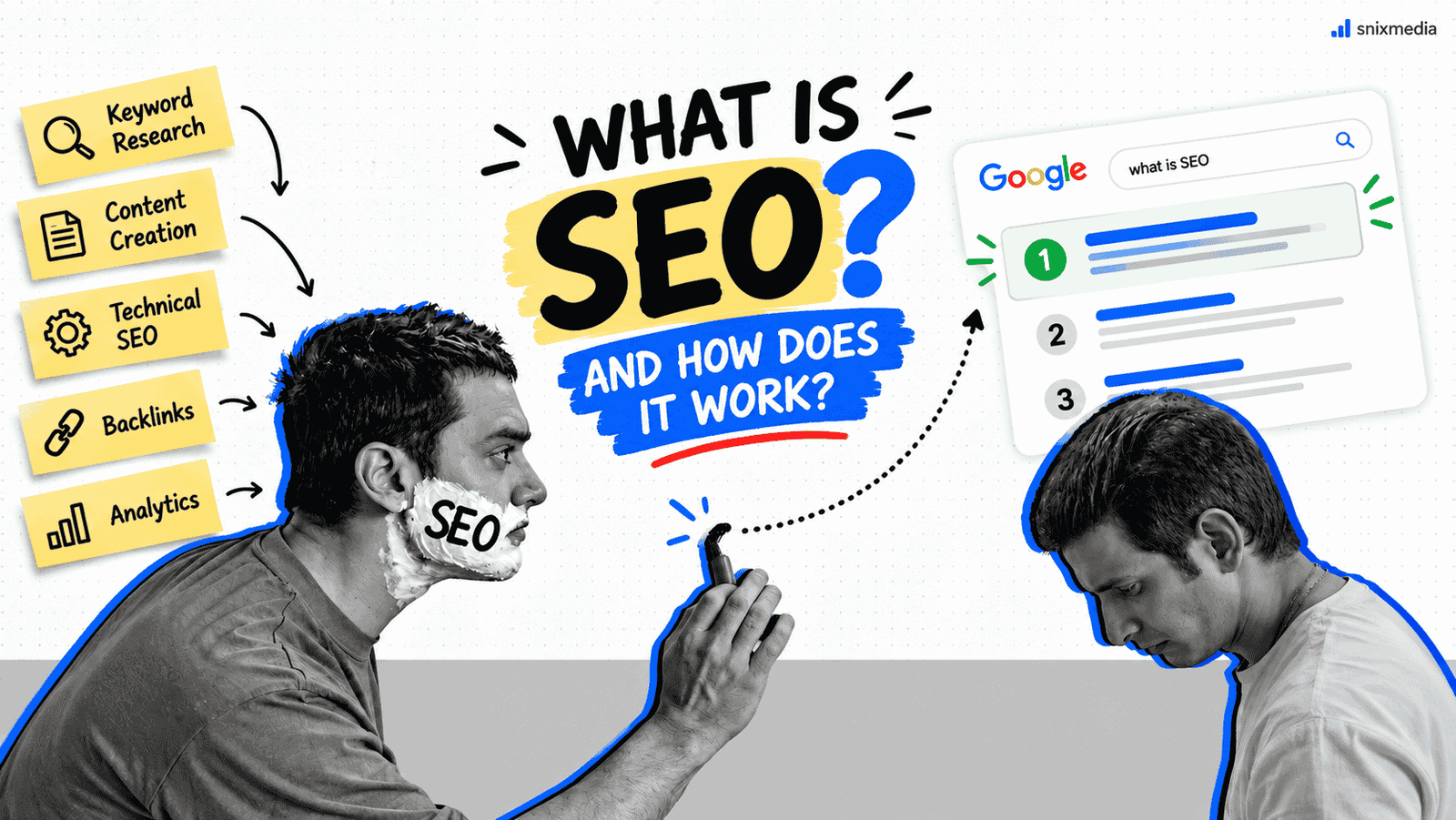
SEO stands for Search Engine Optimization. In the simplest words, it is the practice of improving your website so that search engines like Google and Bing can find it, understand it, and show it to people who are searching for what you offer.
Think about how you use Google yourself. When you type a question, you rarely scroll past the first page. Most people click one of the top three results and move on. SEO is the craft of earning one of those positions, not by paying for it, but by deserving it.
The results you earn this way are called organic results. They are different from paid ads, which appear at the top of the page with a small “Sponsored” label. Ads stop the moment your budget ends. (If you want to explore the paid side too, our guide on how to run Meta Ads for beginners is a good place to start.) Organic rankings, once built well, keep bringing visitors month after month without a fresh payment for every click.
If you are still getting familiar with the wider marketing world that SEO belongs to, start with our foundation guide, What Is Digital Marketing? A Complete Beginner’s Guide . It explains how SEO sits alongside social media, email, content and paid advertising, so you can see the full picture before going deeper.
A Simple Way to Understand SEO
Imagine a huge library with billions of books and no catalogue. Finding one specific book would be impossible. Google is the librarian who built the catalogue. SEO is the act of writing a clear title, a helpful summary and an accurate label on your book so the librarian knows exactly where to place it, and who to hand it to.
A website that is good at SEO is easy to find, easy to trust and easy to use. That is really the whole idea.
2. Why SEO Matters More Than Ever in 2026
Search remains the front door of the internet. People search when they want to learn, compare, buy, book or solve a problem. If your business is missing from those moments, someone else is getting the customer.
Here is why SEO deserves a place in every growth plan.
It brings high-intent visitors.
A person searching “best running shoes for flat feet” is not casually browsing. They are close to a decision. SEO puts your page in front of them at exactly that moment.
It builds long-term value.
A well-optimised article can keep attracting visitors for years. Advertising is like renting attention; SEO is like owning it.
It creates trust.
Users tend to trust organic results more than ads. Ranking well signals that your brand is credible and relevant.
It is cost-effective.
Although SEO needs time and effort, the cost per visitor usually falls sharply as your content library grows.
It supports every other channel.
The content you create for SEO can be reused in social posts, newsletters, videos and sales conversations.
It works with modern search.
Search today includes AI-generated overviews, featured snippets, voice queries and visual results. Clear, well-structured, genuinely helpful content is what these systems prefer to pull from. Strong SEO fundamentals are therefore more valuable, not less, in the AI era.
3. How Search Engines Work: Crawling, Indexing and Ranking
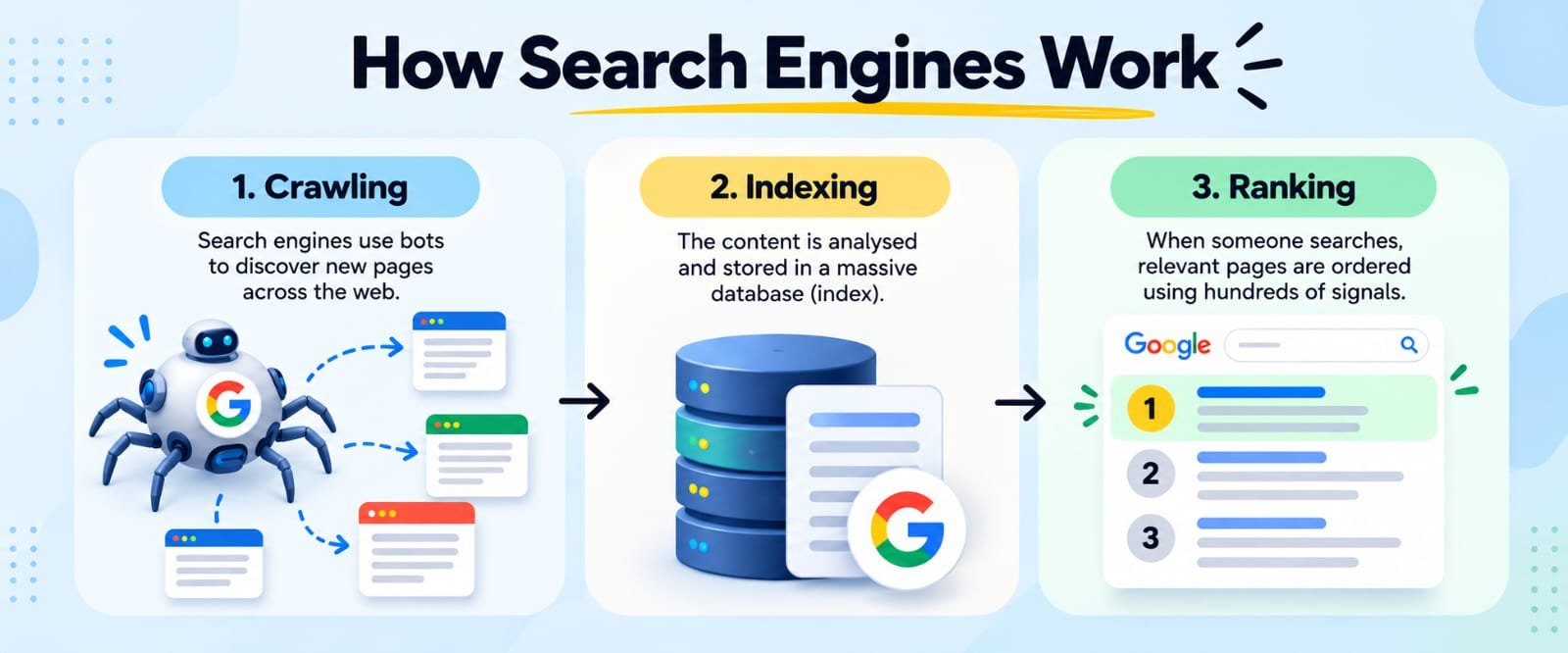
To understand how SEO works, you first need to understand what a search engine does behind the scenes. The process has three main stages.
Stage 1: Crawling
Search engines send out automated programs called crawlers (also known as bots or spiders). Google’s crawler is called Googlebot. These programs travel across the web by following links from one page to another, discovering new pages and revisiting old ones for changes.
Your page can only be crawled if the bot can reach it. That is why internal links, a clean site structure and an XML sitemap matter. A page that no other page links to is like a room with no door; the crawler may never find it.
Things that can block crawling include a wrongly configured robots.txt file, broken links, slow servers and pages hidden behind logins.
Stage 2: Indexing
After crawling, the search engine tries to understand what the page is about. It reads the text, headings, images, links and structured data. Then it stores this information in a gigantic database called the index.
Being crawled does not guarantee being indexed. Pages with thin content, duplicate content or a “noindex” instruction may be left out. If a page is not in the index, it simply cannot appear in search results.
Stage 3: Ranking
When someone types a query, the search engine scans its index and picks the pages most likely to satisfy that person. It then orders them using hundreds of signals. This ordering is called ranking.
The goal of the search engine is simple: give the user the best possible answer, quickly. Your goal as an SEO is to prove that your page is that answer.
What Happens in Less Than a Second
When you press Enter on a search, the engine interprets the meaning behind your words (the search intent), finds matching pages in the index, evaluates quality, relevance and usability signals, considers your location, language and device, and shows a results page. All of this happens in a fraction of a second.
4. What Decides Your Rankings? The Core Ranking Factors
Nobody outside the search engines knows the full list of ranking signals, and they change constantly. But years of testing and official guidance point to a few groups of factors that consistently matter.
Relevance
Does your page match the meaning of the search? Relevance comes from using the right topic, covering it completely, and matching what the searcher actually wants. This is why understanding search intent is so important.
There are four common types of intent:
- Informational: the user wants to learn (“what is SEO”)
- Navigational: the user wants a specific site (“Google Search Console login”)
- Commercial: the user is comparing options (“best SEO tools”)
- Transactional: the user wants to act or buy (“hire SEO consultant”)
If you write a sales page for an informational query, or a long guide for a transactional one, you will struggle to rank no matter how polished the writing is.
Content Quality
Google repeatedly stresses helpful, people-first content. It looks for what it calls E-E-A-T: Experience, Expertise, Authoritativeness and Trustworthiness. Show real experience, cite reliable sources, name the author, and keep information accurate and updated.
Backlinks and Authority
A backlink is a link from another website to yours. Think of each one as a vote of confidence. Links from respected, relevant sites carry more weight than many links from low-quality ones. Authority is earned slowly, by being genuinely worth referencing.
User Experience
Search engines watch whether visitors have a good experience. Fast loading, mobile-friendly layouts, stable pages that do not jump around, and easy navigation all help. Google’s Core Web Vitals measure loading speed, interactivity and visual stability.
Technical Health
Secure HTTPS, clean URLs, a logical structure, working links and correct indexing instructions make it easy for search engines to process your site.
Freshness and Context
For some topics, such as news or trends, recent content wins. Personal factors like location and search history also influence what each person sees.
5. The Four Pillars of SEO
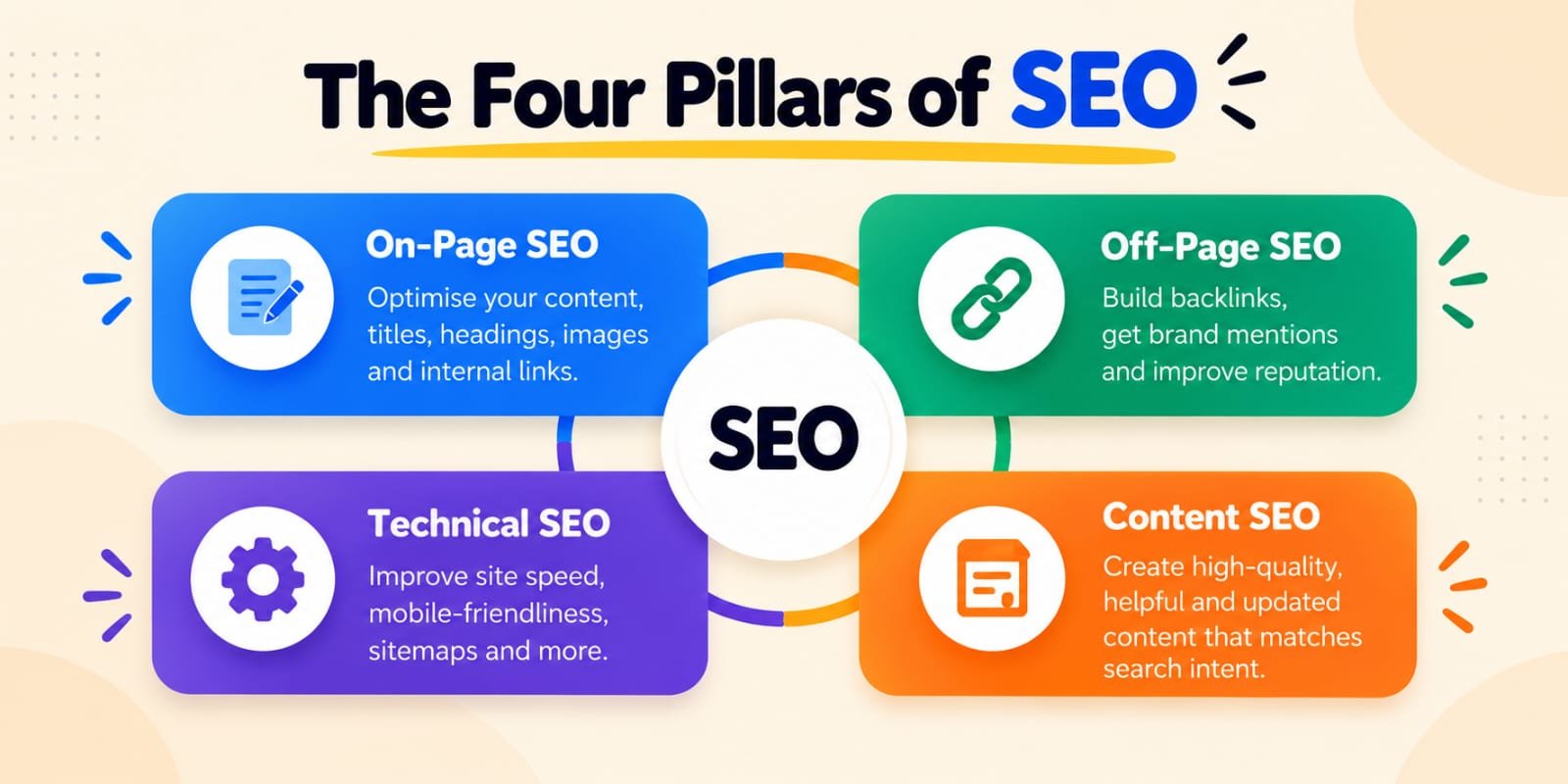
SEO is not one single activity. It is a group of connected practices. The clearest way to learn it is to split it into four pillars: on-page, off-page, technical and content.
5.1 On-Page SEO
On-page SEO covers everything you control directly on a page. It helps search engines and readers understand exactly what the page offers.
Key on-page elements:
- Title tag: The clickable headline in search results. Keep it around 50 to 60 characters, put the main keyword near the start, and make it inviting.
- Meta description: The short summary under the title. It does not directly boost rankings, but a persuasive one lifts click-through rate.
- Headings (H1 to H6): Use one H1 for the main topic and H2/H3 headings to organise sub-topics. Headings make a page scannable for both humans and bots.
- URL structure: Short, readable and keyword-aware, for example /what-is-seo/.
- Content optimisation: Use your main keyword naturally in the opening lines, add related terms and answer follow-up questions.
- Image optimisation: Compress images, use descriptive file names and write meaningful alt text.
- Internal linking: Link related pages together with clear anchor text. This spreads authority and helps crawlers discover content. For example, a reader who wants to learn how to find the right search terms can move on to Keyword Research for SEO: A Beginner’s Guide .
- Schema markup: Structured data that helps search engines understand things like FAQs, reviews, products and articles.
On-page SEO is the fastest area for beginners to see progress, because every change is entirely in your hands.
5.2 Off-Page SEO
Off-page SEO includes signals that come from outside your website. Its heart is building reputation.
Main off-page activities:
- Link building: Earning links through quality content, guest contributions, digital PR, partnerships and resource mentions.
- Brand mentions: People talking about your brand online, even without a link, signals recognition.
- Social signals and sharing: Social media does not directly rank pages, but it spreads content, and spread leads to links and mentions.
- Reviews and reputation: Especially valuable for local businesses.
- Community participation: Answering questions in forums, communities and Q&A platforms with real value.
A word of caution: never buy bulk links or join link schemes. Search engines are very good at spotting unnatural patterns, and the penalty can wipe out months of work.
5.3 Technical SEO
Technical SEO ensures that the foundation of your website is strong. Even brilliant content cannot rank if the site is broken behind the scenes.
Technical checklist:
- Site speed: Compress images, use caching, reduce heavy scripts and choose reliable hosting.
- Mobile-friendliness: Google primarily uses the mobile version of a site for indexing, so your mobile experience must be excellent.
- HTTPS security: An SSL certificate is a basic trust requirement.
- XML sitemap: A file listing your important pages to help discovery.
- Robots.txt: A file that guides crawlers on what to access and what to skip.
- Canonical tags: Tell search engines which version of similar pages is the main one.
- Fixing errors: Repair broken links, redirect chains and 404 pages.
- Site architecture: Keep important pages within a few clicks of the homepage and group related pages logically.
- Core Web Vitals: Monitor loading, responsiveness and layout stability.
You do not need to be a developer to handle most of this. Modern website platforms and plugins take care of many technical basics, but you should understand what each item does.
5.4 Content SEO
Content is the reason people visit and the reason search engines rank you. Content SEO means planning, writing and updating pages that fully satisfy a searcher.
Principles of strong SEO content:
- Start with intent. Before writing, look at what already ranks and understand what the searcher expects.
- Be complete but clear. Cover the topic in depth, yet use simple language, short paragraphs and helpful subheadings.
- Add original value. Use real examples, data, screenshots, experience or a fresh angle. Repeating what everyone else says gives Google no reason to rank you.
- Structure for scanning. Use lists, tables, bold key ideas and summaries.
- Answer related questions. An FAQ section can capture extra searches and featured snippets.
- Keep it updated. Refresh statistics, remove outdated advice and add new insights.
- Write for humans first. Stuffing keywords repeatedly damages readability and rankings.
Content also works best when organised by topic. When you publish several connected articles around one theme and link them thoughtfully, you show search engines that your site knows the subject deeply. That depth builds topical authority over time.
6. Local SEO: Winning Customers Near You
If you run a shop, clinic, coaching centre, restaurant or any business serving a specific area, local SEO is one of the most powerful tools available.
Local SEO helps you appear for searches such as “dentist near me” or “best cafe in Jaipur”, and in the map results known as the Local Pack.
How to improve local visibility:
- Claim and fully complete your Google Business Profile with accurate name, address, phone number, hours, categories and photos.
- Keep your business details consistent everywhere online.
- Collect genuine customer reviews and reply to them professionally.
- Add local keywords naturally to your pages.
- Create location-specific pages if you serve several areas.
- Get listed in trusted local directories.
Local searches often lead to a call, a visit or a purchase within hours, which makes the return on effort especially high.
7. Keyword Research: Where Every SEO Journey Begins
Keywords are the words and phrases people type into search engines. Keyword research is the process of discovering those phrases, understanding the intent behind them, and choosing the ones worth targeting.
Without it, you are guessing. With it, you know what your audience is actually searching for, how many people search, and how hard it is to rank.
Key ideas to know:
- Search volume: How often a keyword is searched.
- Keyword difficulty: How competitive it is to rank.
- Short-tail vs long-tail keywords: “SEO” is broad and difficult; “how to do SEO for a new blog” is specific and easier to win.
- Search intent: The purpose behind the search.
- Keyword clusters: Groups of related phrases that one page or one topic can cover together.
Beginners usually get the best results by targeting long-tail, low-competition keywords first and then moving to bigger terms as their site grows in authority.
8. How to Start SEO: A Step-by-Step Process
Here is a practical roadmap that you can follow whether you are running a blog, a small business site or an online store.
Step 1: Set Clear Goals
Decide what success means: more visitors, more leads, more sales, more sign-ups. Goals guide every later decision.
Step 2: Understand Your Audience
Write down who your ideal visitor is, what problems they face and how they phrase those problems in a search box.
Step 3: Research Keywords
Build a list of topics and keywords. Group them by theme and by intent. Prioritise the ones that are relevant, realistic and valuable to your goals.
Step 4: Analyse the Competition
Search your main keywords and study the top results. What format do they use? What do they cover? What is missing? Your job is to create something clearer, more useful or more complete.
Step 5: Plan Your Site Structure
Organise your website into clear sections, each focused on a main topic with supporting pages beneath it. A tidy structure helps visitors and crawlers move naturally between related pages.
Step 6: Create High-Quality Content
Write pages that solve the searcher’s problem better than the current results. Use simple language, clear headings, examples and visuals.
Step 7: Optimise On-Page Elements
Polish the title, meta description, headings, URL, images and internal links for each page.
Step 8: Fix Technical Foundations
Check speed, mobile experience, security, sitemaps and indexing. Set up Google Search Console and submit your sitemap.
Step 9: Build Authority
Earn links and mentions by publishing genuinely useful resources, sharing your expertise, and building relationships in your industry.
Step 10: Track, Learn and Improve
Monitor rankings, traffic and engagement. Update pages that are close to page one, and improve those that are not performing.
SEO is not a one-time task. It is a cycle of creating, measuring and refining.
9. White Hat vs Black Hat SEO
Not all SEO methods are equal. The two extremes are called white hat and black hat.
White Hat SEO
White hat SEO follows search engine guidelines. It focuses on quality content, honest optimisation, good user experience and natural link earning. Results come more slowly but last.
Black Hat SEO
Black hat SEO tries to manipulate rankings using tricks such as keyword stuffing, hidden text, cloaking, private blog networks, paid link schemes and copied content. These tactics may give quick jumps, but they carry a serious risk of penalties and total loss of visibility.
There is also a middle zone called grey hat, which uses techniques that are not clearly forbidden but are risky. For anyone building a long-term brand, the safest and smartest path is always white hat.
10. Essential SEO Tools for Beginners
You do not need an expensive toolkit to begin. These tools cover most needs.
| Purpose | Tool Examples |
|---|---|
| Performance and indexing | Google Search Console |
| Traffic and behaviour | Google Analytics |
| Keyword ideas | Google Keyword Planner, Google Trends, Ubersuggest |
| Site audits | Screaming Frog, Sitechecker |
| Backlink and competitor data | Ahrefs, Semrush, Moz |
| Page speed | PageSpeed Insights, GTmetrix |
| WordPress optimisation | Yoast SEO, Rank Math |
Begin with the free ones. Google Search Console in particular is essential; it shows which queries bring impressions and clicks, which pages are indexed, and which errors need fixing.
11. How to Measure SEO Success
What you measure shapes what you improve. Track these core metrics:
- Organic traffic: Visitors arriving from unpaid search results.
- Keyword rankings: Where your pages appear for target terms.
- Impressions and click-through rate (CTR): How often you are shown and how often people click.
- Engagement: Time on page, scroll depth and pages per visit.
- Conversions: Sign-ups, enquiries, calls or sales that come from organic visits.
- Backlinks and referring domains: The growth and quality of your link profile.
- Indexed pages: Whether search engines are including your content.
Look at trends over months, not days. Rankings naturally fluctuate, and one small dip is rarely a reason to panic.
12. Common SEO Mistakes to Avoid
Even careful beginners fall into these traps.
- Ignoring search intent. Writing what you want to say instead of what the searcher wants to find.
- Keyword stuffing. Repeating a phrase unnaturally makes content unpleasant and can hurt rankings.
- Publishing thin content. Short, shallow pages rarely satisfy anyone.
- Neglecting mobile users. Most searches happen on phones.
- Slow websites. Heavy images and clutter drive visitors away.
- Skipping internal links. Isolated pages lose authority and discoverability.
- Copying competitors. Duplicate or near-duplicate content offers no unique value.
- Chasing backlinks the wrong way. Quantity without quality is dangerous.
- Forgetting to update. Outdated pages slowly lose ground.
- Expecting instant results. SEO rewards patience and consistency.
13. How Long Does SEO Take to Work?
The honest answer is: it depends. For a brand-new website, it commonly takes three to six months to see meaningful movement, and often six to twelve months to see strong, stable results. Competitive keywords can take longer.
Several factors influence the timeline: the age and authority of your domain, the competitiveness of your topic, the quality and consistency of your content, your technical health and the strength of your backlinks.
The reason SEO takes time is simple. Search engines must first discover your pages, then test how users respond, then gradually build trust in your site. You can support this process by publishing regularly, improving pages based on data and staying patient.
14. The Future of SEO
Search keeps evolving, but the direction is clear.
AI-powered search.
Search engines increasingly summarise answers directly on the results page. To stay visible, create clear, well-sourced, expert content that can be cited.
Voice and conversational queries.
People speak to their devices in full sentences. Natural language and direct answers help.
Visual and video search.
Images and videos are becoming major discovery paths.
Experience and authenticity.
Real experience, original insight and trustworthy authorship stand out in a world of generic, mass-produced content.
Brand strength.
Recognisable brands earn more clicks and more trust.
The tools and formats may change, but the heart of SEO does not: understand people, serve their needs honestly, and make it easy for machines to understand your work.
15. Frequently Asked Questions
1. What is SEO in simple words?
SEO, or Search Engine Optimization, is the process of improving your website so it appears higher in search engine results and attracts more free, relevant visitors.
2. How does SEO work?
Search engines crawl pages, add them to an index and then rank them based on relevance, quality, authority and user experience. SEO improves your website in all of these areas so your pages are chosen for relevant searches.
3. Is SEO free?
You do not pay search engines for organic rankings. However, SEO takes time, effort and sometimes money for tools, content creation, or professional help.
4. What are the main types of SEO?
The main types are on-page SEO, off-page SEO, technical SEO and content SEO. Local SEO is an important specialisation for businesses serving a particular area.
5. How long does it take to see SEO results?
New websites typically need three to six months for early progress and six to twelve months for strong results. Timelines vary by competition and consistency.
6. What is the difference between SEO and SEM?
SEO earns unpaid traffic through optimisation. SEM (Search Engine Marketing) usually refers to paid search advertising, although the term sometimes covers both. If you want to try paid promotion, read how to run Meta Ads for beginners .
7. What is a keyword in SEO?
A keyword is a word or phrase that people type into a search engine. Targeting the right keywords helps your content match real searches.
8. Are backlinks still important?
Yes. Quality backlinks from relevant, trusted websites remain one of the strongest signals of authority.
9. What is on-page SEO?
On-page SEO covers the elements on your own pages that you can optimise, such as titles, headings, content, images, URLs and internal links.
10. What is technical SEO?
Technical SEO ensures that search engines can easily crawl, index and understand your website, covering speed, mobile-friendliness, security, sitemaps and site structure.
11. Can I do SEO myself without any experience?
Yes. Many beginners learn the basics, use free tools and see good results with consistent effort. As your needs grow, you can bring in specialists. For a full learning path, see how to learn digital marketing for beginners .
12. Does social media help SEO?
Social media does not directly raise rankings, but it increases visibility, drives traffic and can lead to mentions and links that help SEO.
13. What is search intent?
Search intent is the reason behind a search: to learn, to find a site, to compare or to buy. Matching intent is critical for ranking.
14. What is the difference between white hat and black hat SEO?
White hat SEO follows search engine guidelines and builds sustainable rankings. Black hat SEO uses manipulative tricks that risk penalties.
15. How often should I update my content?
Review important pages at least every six to twelve months, and update sooner if facts, tools or trends change.
16. Is SEO still worth it with AI search?
Yes. AI-driven search still relies on high-quality, trustworthy content from the web. Good SEO improves your chances of being surfaced and cited.
17. Where should a beginner start with SEO?
Start by understanding what your audience searches for. Our guide to keyword research for SEO is the ideal first practical step, and our overview of digital marketing will help you see where SEO fits in the bigger picture.
16. Final Thoughts
SEO can feel complicated when you first see terms like crawling, indexing, backlinks, search intent and technical optimisation. But the basic idea is straightforward: understand what people are searching for, create genuinely useful content, and make it easy for search engines to discover and understand that content.
Focus on strong fundamentals instead of shortcuts. Research useful topics, publish quality content, keep your website technically healthy, build authority naturally and use real performance data to improve over time.
Leave a Reply