
Think about the last time you bought something. Maybe you searched for a product on Google, watched a review on YouTube, noticed an ad on Instagram, read a few customer opinions, and finally placed the order from your phone. Without realising it, you just walked through a complete digital marketing journey.
Today, almost every business, from a neighbourhood bakery to a global brand, uses the internet to reach customers. People spend hours every day on their phones, searching, scrolling, watching, and shopping. Businesses that show up in those moments win attention, trust, and sales. Businesses that do not, quietly get left behind.
That is exactly why digital marketing has become one of the most important skills and strategies of our time.
In this complete beginner’s guide, we will explain digital marketing in plain, simple language. You will learn what it means, how it works, the major types, why it matters, the tools you will use, the mistakes to avoid, and a clear step-by-step plan to begin, even if you are starting from absolute zero.
What Is Digital Marketing?
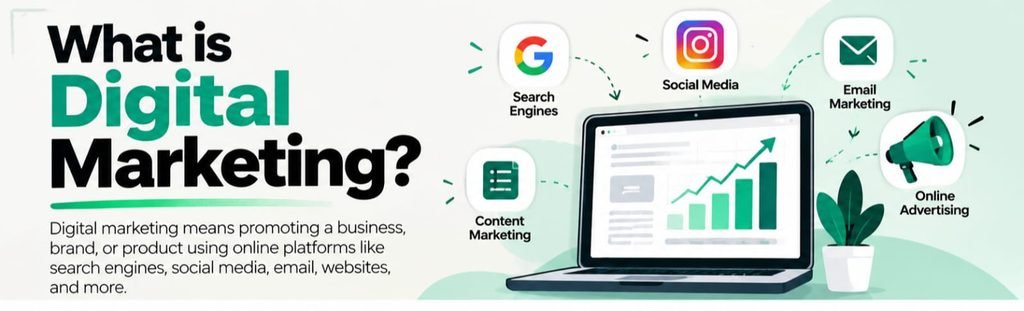
Digital marketing is the practice of promoting a product, service, or brand using the internet and digital devices such as smartphones, laptops, and tablets.
Instead of depending only on newspapers, hoardings, pamphlets, or TV commercials, digital marketing reaches people where they already spend their time: search engines, social media platforms, email inboxes, websites, video platforms, and mobile apps.
In one line: digital marketing means connecting the right message with the right person, at the right time, through online channels.
The goal is not just to be seen. The goal is to be found by people who are actively looking for what you offer, to build trust with them, and to guide them towards an action such as buying, calling, booking, or subscribing.
A Short History: Why Digital Marketing Exploded
The internet changed how people discover and buy things. In the early days, businesses simply built basic websites. Then search engines like Google made it possible for people to find anything in seconds. Social media platforms turned everyday people into publishers and communities. Smartphones and cheap mobile data put the internet in every pocket.
As a result, customer behaviour changed forever. People now research before buying, compare options, read reviews, watch videos, and ask friends online. Marketing had to follow the customer, and digital marketing became the natural answer.
How Does Digital Marketing Work?
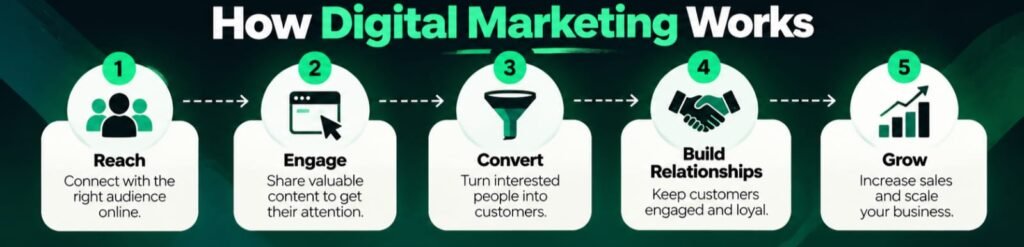
At its heart, digital marketing follows a simple flow that is often called the customer journey:
- Awareness: A person first discovers your brand through a Google search, a social media post, a video, or an ad.
- Interest: They visit your website, read your blog, watch your content, or follow your page. They begin to understand what you do.
- Consideration: They compare you with other options, read reviews, and check whether you seem trustworthy.
- Conversion: They take an action, such as making a purchase, filling a form, calling you, or booking a service.
- Loyalty: After the sale, you stay in touch through emails, messages, and helpful content so the customer returns and recommends you to others.
What makes digital marketing so powerful is that every stage can be tracked and measured. You can see how many people saw your content, who clicked, who stayed, and who became a customer. This data helps you improve continuously instead of guessing.
The Main Types of Digital Marketing
Digital marketing is not one single thing. It is a group of channels and methods that work together. Here are the most important ones.
1. Search Engine Optimization (SEO)
SEO is the process of improving your website so that it appears higher on Google and other search engines when people search for related topics. It includes keyword research, creating helpful content, improving website speed, making the site mobile-friendly, and building credibility through quality links.
SEO takes patience, often a few months, but the traffic it brings is long-lasting and does not require paying for every click. For many businesses, SEO becomes one of the strongest and most affordable growth engines.
2. Content Marketing
Content marketing means creating useful blogs, videos, guides, infographics, and podcasts that answer your audience’s questions. Instead of pushing a sale immediately, you help first and earn trust.
When people find your content valuable, they naturally start to see you as an expert and are more likely to buy from you.
3. Social Media Marketing (SMM)
Platforms like Instagram, Facebook, LinkedIn, X, and YouTube let brands connect directly with people. Social media marketing includes posting regularly, running campaigns, sharing stories and reels, replying to comments, and building a community around your brand.
It is especially useful for brand awareness and customer relationships.
4. Pay-Per-Click Advertising (PPC)
In PPC, you pay for ads on platforms such as Google, YouTube, Instagram, and Facebook. Depending on the campaign type, advertisers may pay for clicks, impressions, views, or other actions.
PPC can be one of the fastest ways to bring targeted visitors and leads, making it useful when launching a new offer or when faster visibility is required.
5. Email Marketing
Email allows you to speak directly to people who have already shown interest in your business. Newsletters, welcome sequences, offers, and reminders help you build lasting relationships.
Email can be a highly cost-effective channel because you build your own audience instead of depending entirely on a social platform’s algorithm.
6. Affiliate Marketing
In affiliate marketing, other people or websites promote your product and earn a commission when they generate an agreed result, commonly a sale.
It is a performance-based model that allows businesses to reward partners for measurable results.
7. Influencer Marketing
Brands partner with creators who already have the attention and trust of a particular audience. Recommendations from relevant creators can help businesses introduce their products to potential customers in a more natural format.
8. Mobile and WhatsApp Marketing
Since people use smartphones throughout the day, messaging apps, SMS, and mobile-friendly campaigns have become important ways to reach customers.
WhatsApp, in particular, is widely used by Indian businesses for enquiries, updates, customer communication, and support.
9. Online Reputation Management
Reviews, ratings, and public opinions can strongly influence buying decisions. Managing your Google Business Profile, responding to reviews, and handling feedback professionally can help build and protect trust.
Digital Marketing vs Traditional Marketing
Traditional marketing includes TV, radio, newspapers, magazines, and billboards, while digital marketing uses online channels.
- Cost: Digital campaigns can often begin with smaller budgets, while many traditional advertising formats require larger upfront spending.
- Targeting: Digital platforms can target audiences using factors such as location, interests, demographics, and behaviour.
- Measurement: Digital marketing provides data on metrics such as impressions, clicks, conversions, and sales.
- Interaction: Digital channels allow two-way conversations through comments, messages, reviews, and communities.
- Flexibility: Many digital campaigns can be edited, paused, tested, or optimised while they are running.
The two approaches are not enemies. Many successful businesses combine traditional and digital marketing depending on their audience, goals, and budget.
Related: Digital Marketing vs Traditional Marketing: Key Differences
Why Is Digital Marketing Important?
Here are some of the biggest reasons businesses take digital marketing seriously.
- Your customers are already online. Many buying journeys now begin with a search, social media post, video, review, or online recommendation.
- It can be budget-friendly. Businesses can start small, test campaigns, measure results, and increase spending when something works.
- It is measurable. Analytics can show which campaigns and content contribute to traffic, leads, and conversions.
- It can reach relevant audiences. Digital targeting helps businesses focus their marketing on people more likely to be interested.
- It builds trust and brand identity. Helpful content, useful information, and positive customer experiences can strengthen credibility.
- It works around the clock. Websites, articles, videos, and other online assets can continue attracting visitors outside normal business hours.
- It gives smaller businesses opportunities to compete. A focused strategy can help a smaller company reach audiences without requiring the media budget of a major brand.
Key Digital Marketing Terms Every Beginner Should Know
- Traffic: The number of visitors coming to your website.
- Lead: A person who has shown interest in your product or service, for example by filling out a form or sending a message.
- Conversion: When a visitor completes a desired action such as buying, booking, or subscribing.
- Conversion Rate: The percentage of visitors who complete the desired action.
- CTR (Click-Through Rate): The percentage of people who click a link or ad after seeing it.
- CPC (Cost Per Click): The average amount paid for each click in a pay-per-click advertising campaign.
- ROI (Return on Investment): A measure used to compare the return generated with the amount invested.
- Keyword: A word or phrase people type into a search engine.
- Backlink: A link from another website pointing to your website.
- Landing Page: A page created around a specific campaign or goal, often designed to encourage visitors to take an action.
- Analytics: Data used to understand how websites, content, and campaigns are performing.
Essential Digital Marketing Tools for Beginners
You do not need expensive software to start. Several widely used tools can help beginners learn and manage digital marketing.
- Google Analytics: Helps you understand website traffic and visitor behaviour.
- Google Search Console: Shows how your website performs in Google Search and highlights indexing and technical issues.
- Google Keyword Planner: Helps research keywords and search demand for advertising and content planning.
- Canva: Useful for creating social media graphics, banners, presentations, and thumbnails.
- Meta Business Suite: Helps manage Facebook and Instagram content and business activity.
- Email marketing tools: Platforms such as Mailchimp can help businesses build lists and send email campaigns.
- AI assistants: AI tools can help with brainstorming, research starting points, outlines, and drafts. Important information and final content should still be reviewed carefully by a human.
How to Get Started With Digital Marketing: A Step-by-Step Plan
Step 1: Understand the Basics
Learn what each major digital marketing channel does before deciding where to specialise. Build a clear understanding of SEO, content, social media, paid advertising, email, and analytics.
Step 2: Define Your Goal
Decide whether you want website visitors, sales, followers, leads, bookings, or phone enquiries. A clear goal makes it easier to choose the right strategy.
Step 3: Know Your Audience
Understand who your customers are, what problems they face, what they search for, and which platforms they use.
Step 4: Build a Simple, Fast Website
Your website acts as your digital home. Keep it clean, mobile-friendly, fast, easy to navigate, and provide visitors with a clear next action.
Step 5: Pick One or Two Channels First
Do not try to master every marketing channel simultaneously. Starting with SEO and one relevant social platform can make the learning process more manageable.
Step 6: Create Valuable Content Regularly
Publish useful blogs, short videos, guides, or social posts that solve real problems for your audience. Consistency matters more than publishing large amounts of low-quality content.
Step 7: Track and Improve
Use analytics and search data to understand what attracts visitors and generates useful actions. Improve successful strategies and change the ones that are not producing results.
Step 8: Practise and Stay Updated
Digital marketing changes frequently. Platforms evolve, algorithms are updated, and customer behaviour shifts. Keep learning and test ideas on real projects.
Career Scope in Digital Marketing
Digital marketing offers several career paths. Depending on your interests and skills, you can work in areas such as:
- Search Engine Optimization (SEO)
- Social Media Marketing
- Content Marketing
- Performance Marketing
- Email Marketing
- Web Analytics
- Brand Strategy
- Digital Advertising
Digital marketing skills can also be used for freelancing, agency work, or growing your own website, brand, or business. Practical projects can be especially useful for building a portfolio and demonstrating your skills.
Common Beginner Mistakes to Avoid
- Trying to be active on every platform instead of mastering a few relevant ones.
- Posting randomly without clear goals or a content strategy.
- Depending entirely on paid advertising while ignoring organic channels.
- Copying competitors instead of developing a distinct brand identity.
- Failing to track results and learn from marketing data.
- Focusing entirely on selling rather than providing useful information.
- Neglecting the experience of mobile users.
- Expecting immediate results from strategies that require time and consistency.
The Future of Digital Marketing
Digital marketing continues to evolve. Artificial intelligence is helping marketers analyse information, automate tasks, and create content more efficiently. Short-form video has become an important content format, while local search, personalisation, automation, and conversational experiences continue to shape online marketing.
Technologies and platforms will keep changing, but the fundamentals remain similar: understand your audience, solve real problems, communicate clearly, measure results, and continually improve your strategy.
Frequently Asked Questions About Digital Marketing
1. What is digital marketing in simple words?
Digital marketing means promoting a product, service, or brand online through channels like search engines, social media, email, websites, and digital advertising.
2. Is digital marketing a good career?
Digital marketing offers career opportunities across areas such as SEO, content, social media, advertising, analytics, and email marketing. It can also support freelancing and entrepreneurship.
3. Do I need a degree to learn digital marketing?
No. A specific degree is not required to begin learning digital marketing. Practical skills, real projects, and an understanding of marketing principles are important.
4. Which type of digital marketing is best for beginners?
SEO and content marketing are useful starting points because they teach core concepts such as search intent, audience research, content creation, and online visibility.
5. How long does digital marketing take to show results?
The timeline depends on the channel, competition, budget, and strategy. Paid campaigns can generate traffic quickly, while SEO and content strategies commonly require longer periods to build meaningful organic visibility.
6. Can small businesses use digital marketing?
Yes. Small businesses can use digital marketing to reach local or targeted audiences while controlling their budgets and measuring campaign performance.
7. Is digital marketing better than traditional marketing?
Each has different strengths. Digital marketing provides detailed targeting, measurement, and flexibility, while traditional channels can still be valuable for certain audiences and campaigns. Many businesses combine both.
8. Is coding required for digital marketing?
No. Coding is not required for most digital marketing roles, although basic knowledge of websites, HTML, and technical concepts can be useful.
9. How much does digital marketing cost?
Costs depend on your goals, industry, channels, tools, advertising budget, and whether you manage campaigns yourself or hire professionals.
10. What is the difference between SEO and PPC?
SEO focuses on earning organic search visibility over time, while PPC uses paid advertising to gain visibility and traffic based on the campaign’s bidding and pricing model.
11. Can I learn digital marketing on my own?
Yes. Tutorials, documentation, blogs, courses, and free tools can teach the fundamentals. Applying what you learn to a real website or project is particularly valuable.
12. Which social media platform is best for business?
It depends on your target audience and content. Consumer brands often use Instagram and Facebook, LinkedIn is widely used for professional and B2B audiences, and YouTube is useful for video-based educational and entertainment content.
13. How do I measure digital marketing success?
Measure metrics that match your business goal. These can include website traffic, leads, conversion rate, revenue, cost per lead, customer acquisition cost, and return on investment.
14. Should I hire an agency or do digital marketing myself?
It depends on your available time, skills, budget, and campaign complexity. Learning the fundamentals yourself can help you understand the process, while specialists or agencies can handle areas that require additional expertise or resources.
Conclusion
Digital marketing has become a major way for businesses to connect with people who are searching, researching, comparing, and buying online.
You do not need to master every channel at once. Understand the fundamentals, choose a manageable starting point, create useful content, measure what happens, and improve based on real results.
Every experienced digital marketer started by learning the basics and applying them to real projects. Consistent practice is what turns marketing knowledge into a useful skill.
Grow Your Brand With Snix Media
At Snix Media, we help businesses grow online with strategies that are simple, smart, and result-driven.
Ready to take your brand to the next level? Get in touch with us today.
Leave a Reply